|
Algonquin Park
Wilderness Canoe Trip
Cedar Lake
to Mink Lake Region
September 10-16, 2000
by Norm
Hooper
Part
3
|
During
the night, Norm R. had to be awakened a few times by
Wayne because of his constant snoring. It wasn’t
until morning that Norm R. informed us that Wayne had
disturbed him in the middle of one of the most beautiful
dreams he had ever experienced. In it, gorgeous ladies
were frolicking about merrily; but unfortunately, he was
never able to see any of their faces! Norm R. indicated
that he was quite sure his wife wasn’t in the dream
(apparently this was a familiar occurrence in past
dreams)! This resulted in many "chuckles"
throughout the week and it became an unwritten rule that
Norm R. was not to be disturbed during the night, whether
he was snoring or not. Unfortunately, Norm R. was never
able to return to this particular dream and we will never
know the ending – something to be said about the
"spirits of the wilderness"!
 Sept
12th – Energy eluded us this
morning as a result of yesterday’s arduous
portaging. Our challenge was the muscle stiffness we were
experiencing. Our counterattack was to spend some time
just vegetating on a bench with a cup of coffee and
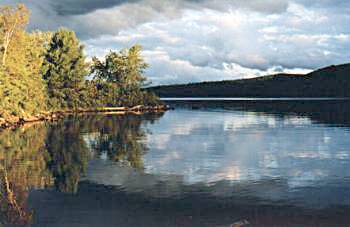
enjoying the view of the countryside across the calm
lake. Surprisingly, our shoulder and back muscles were
not as sore as the previous evening - the tossing and
turning during the night in an effort to find a
comfortable spot on the hard ground did not seem to
worsen our delicate status. After reviewing our map, we
decided to take a side trip to Hurdman Lake and scuttle
our original plan to Carl Wilson Lake - a trip that would
have initially involved three long, strenuous portages up
and over a steep escarpment and back again. At this
point, we had to remind ourselves of the importance of
"flexibility" (forgive the pun!!) on this trip
because of our lack of a fourth canoeist and that our
goal was to enjoy ourselves and not to encounter too much
"hardship". Sept
12th – Energy eluded us this
morning as a result of yesterday’s arduous
portaging. Our challenge was the muscle stiffness we were
experiencing. Our counterattack was to spend some time
just vegetating on a bench with a cup of coffee and
enjoying the view of the countryside across the calm
lake. Surprisingly, our shoulder and back muscles were
not as sore as the previous evening - the tossing and
turning during the night in an effort to find a
comfortable spot on the hard ground did not seem to
worsen our delicate status. After reviewing our map, we
decided to take a side trip to Hurdman Lake and scuttle
our original plan to Carl Wilson Lake - a trip that would
have initially involved three long, strenuous portages up
and over a steep escarpment and back again. At this
point, we had to remind ourselves of the importance of
"flexibility" (forgive the pun!!) on this trip
because of our lack of a fourth canoeist and that our
goal was to enjoy ourselves and not to encounter too much
"hardship".
in the narrows |
plant growth on a log |
By 10 am, we were on
Cedar Lake heading in a westerly direction and into a
slight headwind. Wayne took over Norm H’s canoe and
went solo. At the end of Little Cedar Lake, we had to
draw cautiously on some keen navigating tactics in order
to avoid striking the sharp shoals lying beneath the
dark, shallow waters. The various colours on the rocks
from canoe bottoms definitely indicated that other
canoeists were not so fortunate – it’s a
"jolt of the senses" when one does hit an
object, like a shoal, unexpectedly – Wayne
discovered this on his return trip. Once through this
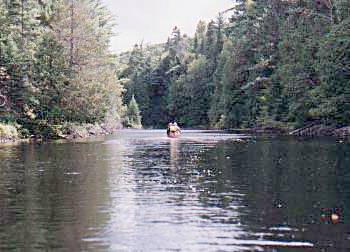
passage, we entered a narrow channel with ends of logs
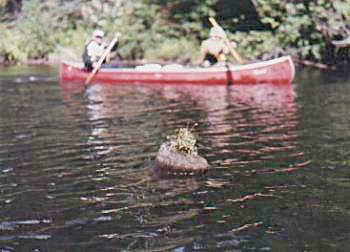
partially protruding out of the water’s surface. One
such log was very unique because, over the years, it had
collected enough soil and seeds from the passing winds to
have plants growing in a crevice - it made for an
exquisite picture in a natural setting. We passed under
the cement train bridge and into Aura Lee Lake where we
met a father and son loading their canoe, their
destination was Mink Lake. After viewing the initial part
of the portage to Carl Wilson Lake, we were satisfied
with our decision not to venture there.
At 11 am, we reached the beginning of
our next portage leading to Laurel Lake. We decided to
leave Wayne’s canoe at this location and utilize one
canoe, with Norm R. agreeing to be the "middle
man" on our journey to Hurdman Lake. It was a short
distance to cross Laurel Lake and an interesting sight
awaited us – eight canoes with their occupants
attempting to make the "day’s catch"! In
order to enter the main part of Hurdman Lake, it required
hauling our canoe over yet another beaver dam. Again, at
the end of the lake next to a stream, we met two
canoeists fishing – their catch, at this point, were
a couple of bass. The hills on both sides of the lake
held evidence of logging having taken place approximately
75-100 years ago by the growth and size of specific
tress, especially the birch. We stopped at a campsite to
prepare lunch. A light drizzle attempted to spoil our
meal and we took shelter under a large pine to cook our
soup and to keep dry. Just as we finished eating, it
stopped raining and we continued on with our return trip.
Instead of returning via the two portages attached to
Laurel Lake, we decided to follow a stream involving
three smaller portages that would lead us to where
Wayne’s canoe was stored. As hindsight would have
it, if we had known what we were about to encounter, we
would have returned by way of the original route. The
stream’s water level was very low with large
boulders protruding everywhere, with many submerged rocks
barely seen under the dark water – paddling was
impossible with the three of us in one canoe. At the
second portage, a near disaster occurred when Norm H.
slipped and his foot became lodged between two rocks. He
was fortunate to have only received some scrapes and
bruises as he could have easily broken his leg.
Just as we located Wayne’s canoe,
dark clouds descended upon us and it began to rain again.
We took shelter under some trees for about ten minutes.
Halfway down Aura Lee Lake, a fierce wind relentlessly
pounded sheets of rain upon us – thunder and
lightning was our main concern, but we were denied that
experience! Paddling with a tailwind, we quickly reached
the cement train bridge to take protection underneath.
After a short delay, we continued on down the channel,
through the shallow shoal passage and onto Little Cedar
Lake. By this time, the winds had picked up again from a
westerly direction and the waves became our advantage.
Just before reaching our base camp at 3:45 pm, two loons
greeted us and welcomed our return. After
"skinny" dipping and washing some laundry, we
sat with hot chocolate in hand around a campfire. We
began to notice a similar pattern in the weather - strong
winds blowing over the lake in mid-afternoon and lasting
until about 5 pm. It would be something to watch out for
during future outings.
When Norm H. turned over his canoe, a
deep gouge, approximately the size of a dime, was found
in the outer shell, the result of hitting a shoal as we
passed through the narrows. Luckily, it didn’t
penetrate through the white fiber or else a strip of duck
tape would have been required - a definite repair job in
the offering after this trip – the canoe’s
"battle scars" will become "fuel" for
future trekking stories to tell the grandchildren!!
In the back of our campsite, located
next to the abandoned railway line, was an old,
dilapidated log building. This
premise must have been used as a tourist resort or for
logging purposes in days gone by. Two large stone
chimneys and fireplaces were still in tack and it was
evident that it once had a large veranda on two sides.
The door to the cellar was open; however, it was too
dangerous to venture within the fallen structure in the
event the flooring collapsed. Further inspection revealed
that there were other outbuildings nearby; a garage where
a vehicle was once stored (we could still smell the oil
and see the trail where the vehicle traversed), a storage
shed, a few remaining logs of two large cabins (perhaps
for staff or loggers) and an underground shelter, similar
to a root cellar, containing many empty diesel fuel cans.
In the gully in front of the shelter entrance were
ruminants of old vehicle parts strewn helter-skelter. We
came to the conclusion that the vehicle motor had been
used as a generator, because among the trees, we could
see old insulators and wiring that carried electricity to
the main lodge. In the dead grass next to the lodge, Norm
H. found two insulators of different styles that were to
be kept as souvenirs. In front of our campsite, there
still existed the remains of rusted wheels and axils and
a partially dismantled trolley sitting on smaller rail
tracks semi submerged in the lake. It may have been used
to transport provisions and people from larger boats or
for hauling boats from the lake onto the shore. Norm H.
made a "mental note" to contact Parks Ontario
for more information on this site.
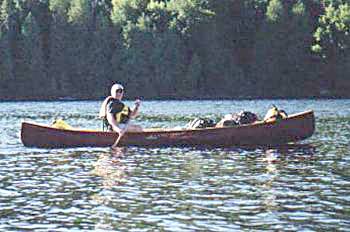
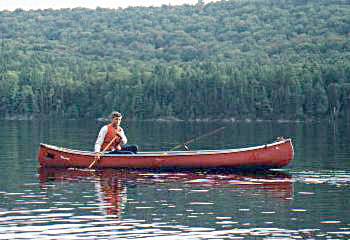
Norm Hooper soloing to the next site |
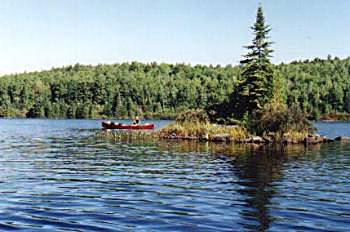
Norm Hooper passing an island |
Our supper
that evening consisted of Mexican chili, veggie pasta,
bannock bread and the last of the wine – a hearty
reward after the efforts of our day. In the latter part
of the evening, except for the occasional calling of the
loons, all was calm again. The moon was so bright that
the surroundings took on the appearance of
"daylight" – what a fantastic view and
ambience – making the efforts of this trip so
worthwhile.
copyright
2001 by Norm Hooper
http://www.canoestories.com/brent1.htm
|