|
Algonquin
Park Canoe Camping Trip
September 12-18, 1999
by Norm
Hooper
Part 2
On to North Tea Lake and a day trip to Bigger
Lake
|
Sept 14th
- The loons were very vocal during the night; however,
getting up to a loud "yell" out over the lake
from Norm H. was a usual morning event to get everyone
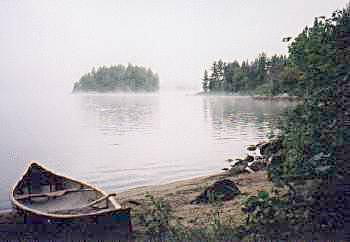
activated. The lake was very calm with a cool wind, a sun
rising on the east hillside and mist settling on the lake
in the cove around the point.
At 10:15 am, we started off across Manitou Lake with
Wayne in the stern this time. It was still sunny;
however, the wind picked up and clouds were approaching
which caused the waves to increase in size. Passed Pine
Island with three canoes along the rocky shore and
several teenagers could be seen jumping from a rock ledge
into the lake. The wind increased and we had to stay
close to shore before crossing out into the middle of the
lake and around a large island. We stopped to check our
map and to discuss our strategy in passing between a
peninsula and an island further down the lake. At the
peninsula, the three canoes and nine youths passed us
chanting camp songs, they were certainly in the
"wilderness spirit". We appreciated their
opportunity and only wished that such a school program
existed during our youth. We crossed the lake paddling
against strong winds and into waves with white caps and
entered an inlet which would bring us to the portage (the
one on the right - better beaches) to North Tea Lake.
Clouds indicated that a storm was approaching.
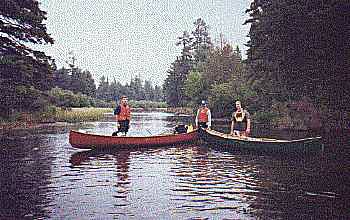 The initial entry into the
portage (550 yds) was without question another challenge
- extremely steep with rocks and slippery mud on the
winding trail. Up and over the escarpment during a light
rain, brought us to North Tea Lake. We had carried our
backpacks while carrying the canoes; thereby only having
to return once for the remaining equipment. Even though
it was enduring and challenging, I (Norm H.) did not find
the portaging too difficult, and now appreciated the
training undertaken during the summer in preparation for
this trip. We decided to paddle a short distance to a
campsite where we would have our lunch; however, upon our
arrival, there were already campers on site. After
crossing the inlet during a light rain and rounding a
point next to an island, we discovered a protected sandy
beach in a small cove with steps leading to an excellent
campsite on a peninsula. Following a hardy lunch, the
weather made the decision for us (the strong wind
velocity made crossing the lake too dangerous) to make
camp at this site. At 4 pm, just as we were pitching our
tents, it started to HAIL for about 30
seconds. We could not believe it! The initial entry into the
portage (550 yds) was without question another challenge
- extremely steep with rocks and slippery mud on the
winding trail. Up and over the escarpment during a light
rain, brought us to North Tea Lake. We had carried our
backpacks while carrying the canoes; thereby only having
to return once for the remaining equipment. Even though
it was enduring and challenging, I (Norm H.) did not find
the portaging too difficult, and now appreciated the
training undertaken during the summer in preparation for
this trip. We decided to paddle a short distance to a
campsite where we would have our lunch; however, upon our
arrival, there were already campers on site. After
crossing the inlet during a light rain and rounding a
point next to an island, we discovered a protected sandy
beach in a small cove with steps leading to an excellent
campsite on a peninsula. Following a hardy lunch, the
weather made the decision for us (the strong wind
velocity made crossing the lake too dangerous) to make
camp at this site. At 4 pm, just as we were pitching our
tents, it started to HAIL for about 30
seconds. We could not believe it!
 If the weather was to continue
to be miserable the next day, our decision was to return
to Manitou Lake and paddle some other areas of the Park
rather than challenge the lake and put ourselves at risk,
as we didn’t have to prove anything to anyone and
our main goal was to have fun on this trip. We did notice
and mention that the four of us worked well as a team
(excellent communication with laughter thrown in as well
as looking out for and complementing one another). So
far, we have enjoyed the trip and put aside all
obstacles. If the weather was to continue
to be miserable the next day, our decision was to return
to Manitou Lake and paddle some other areas of the Park
rather than challenge the lake and put ourselves at risk,
as we didn’t have to prove anything to anyone and
our main goal was to have fun on this trip. We did notice
and mention that the four of us worked well as a team
(excellent communication with laughter thrown in as well
as looking out for and complementing one another). So
far, we have enjoyed the trip and put aside all
obstacles.
The sun appeared later that afternoon and we went for
a swim in the shallow waters which were quite warm. Norm
H. walked along the shoreline to the next campsite and
talked to three campers who were in the process of
building a sweat lodge on their beach. At 8 pm, supper
consisted of spaghetti with pepperoni and soup and just
as we finished, the wind picked up and we could tell that
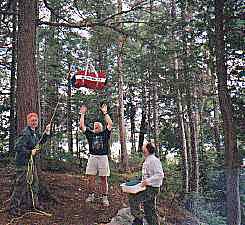
it was going to rain. Dishes were immediately cleaned and
the food bag hung among the trees just as it started to
rain quite hard. We went to our respective tents, but
nobody seemed to mind going to bed early, even though
Norm R. and John wouldn’t stop talking and laughing.
 Sept 15th
- Wayne and Norm H. were up at 3 am and noticed that the
sky was clear and the stars numerous, but the wind was
cool. Norm H. and John heard a wolf howling across the
lake during the night. Sept 15th
- Wayne and Norm H. were up at 3 am and noticed that the
sky was clear and the stars numerous, but the wind was
cool. Norm H. and John heard a wolf howling across the
lake during the night.
We were up and getting the fire going at 6:50 am and
had apple pancakes and coffee for breakfast. There was a
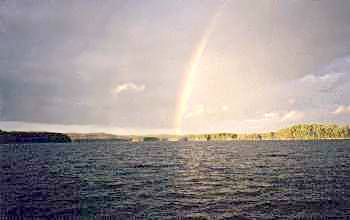
mixture of cloud and a few rays of sun and by 8 am, a
beautiful rainbow could be seen across the lake with a
smaller one next to it.
We have decided to use this site as a base camp and
canoe to Biggar Lake for the day. We felt that with the
present weather conditions, it would be too risky and
labourious to go through the three portages from Biggar
Lake to Three Mile Lake, and then the
"humongous" portage (2800 m) thereafter to
Manitou Lake. We came to the Park to enjoy ourselves and
not to endure an ERT exercise. We plan on returning to
Manitou Lake tomorrow and hopefully stay at the same site
among the pine trees on the plateau.
We have been having some trouble with the Coleman
stove and thought that it might be caused by dirty fuel
or it required a good cleaning. We have Wayne’s
single burner stove as a backup. The latrine is something
else to experience - single holer with a lid covering it,
right out in the open among the pines, but it works
wonders if you have a dire need for it.
At 9:30 am, we set off down North Tea Lake, using the
rock on the point as a return reference. The sky was
fairly cloudy with some wind while the waves were
moderately challenging. We followed the shoreline for
about a mile and then crossed a large cove and around a
peninsula into a narrow channel where John and Norm R.
momentarily grounded onto a sand bar. Before entering
Mangotasi Lake, we passed two loons about 20 feet from us
- they didn’t even fly away. Just before entering a
small pond at the first portage, Norm R. bellowed his
"moose call" and seconds later, we could heard
a loud banging and crashing sound. Immediately we thought
that it was a moose running in the woods from the marsh.
We heard the sound a second time and this time we were
sure it had to be a moose. As we rounded the bend, there
were four female canoeists from the Toronto area at the
portage who had just placed their canoes down onto the
rocky shoreline. This was the noise we had heard and not
that of a "lovesick moose".
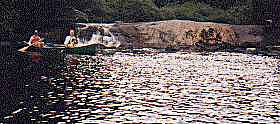 The portage was only 240 yds and consisted
of only two trips. We were protected among the trees in
the woods during our portaging as it started to rain.
After crossing a small pond, we entered a second portage
next to a small waterfall. The waterway was very narrow
and shallow with rocks protruding everywhere. John and
Norm R. went through; however, Wayne traversed this
stretch alone while Norm H. walked a path along the
stream until he was able to get back into the canoe. A
few minutes later, we were at the third portage (140 yds)
and the trail was much easier to walk without any steep
grades. During this period, the sun appeared and then
disappeared behind clouds that brought cold winds and
rain. When the sun did appear again during out lunch
break, it was quite pleasant. The portage was only 240 yds and consisted
of only two trips. We were protected among the trees in
the woods during our portaging as it started to rain.
After crossing a small pond, we entered a second portage
next to a small waterfall. The waterway was very narrow
and shallow with rocks protruding everywhere. John and
Norm R. went through; however, Wayne traversed this
stretch alone while Norm H. walked a path along the
stream until he was able to get back into the canoe. A
few minutes later, we were at the third portage (140 yds)
and the trail was much easier to walk without any steep
grades. During this period, the sun appeared and then
disappeared behind clouds that brought cold winds and
rain. When the sun did appear again during out lunch
break, it was quite pleasant.
Entering Biggar Lake, we found a campsite and put our
canoes right onto the site to offer a form of wind
protection while preparing our lunch. At this time, we
decided not to continue onto Biggar Lake due to the
climatic conditions. A better plan was to return to our
base camp and enjoy the rest of the day.
At 2:30 pm on our return to the first portage, we met
some teenagers who were waiting for the rest of their
group - sixteen in all with eight canoes. We would be
meeting the rest of the group at various stages during
the next two portages. They were a school group from
Brantford and they were planning to camp on Biggar Lake
for the night.
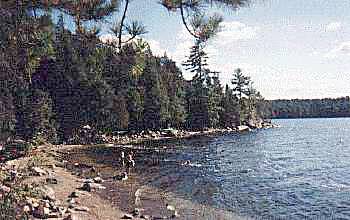 Upon entering North Tea Lake, the clouds
were becoming whiter, the sky bluer and the sun, a sure
welcome. At first the waves were moderate, but increased
in size with some white caps, especially when we rounded
the point with the big rock. We had to keep our canoes
into the wind or at a slight angle in order to avoid
capsizing or getting wet. Upon entering North Tea Lake, the clouds
were becoming whiter, the sky bluer and the sun, a sure
welcome. At first the waves were moderate, but increased
in size with some white caps, especially when we rounded
the point with the big rock. We had to keep our canoes
into the wind or at a slight angle in order to avoid
capsizing or getting wet.
At camp, we immediately went for a refreshing swim in
the shallow waters of the sandy beach. We sat on the warm
rocks in the sun and constructively talked about our trip
and how we could make a future trip more efficient for
next year, ie. more backpacks rather than bags, two
single burner stoves, etc.
We had an excellent pasta supper and our usual
communication always resulted in laughter. Just as it got
dark at approximately 8 pm, wolves across the lake howled
at the half moon for the next three hours. The wind died
down and there was silence throughout the park, except
for the wolves, the loons and our campfire. At the beach,
the sky was so full of stars with the Big Dipper
appearing big and close - we could almost reach out and
grab it. "A shooting star" was seen crossing
the sky for a split second - the whole scene was simply
"majestic". There was an "object" in
the distant western horizon sky with red and green
lights, which didn’t appear to be moving for a long
period of time; however, it did cast a reflection onto
the lake so it wasn’t a star nor a satellite. Back
at the campfire, with everyone listening attentively,
Wayne talked about his experiences while on northern
detachment duties.
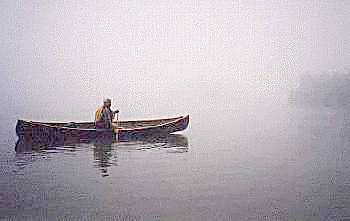 Sept 16th
- Up at 6:50 am with a damp, cold fog covering the lake -
Wayne took some photos of the island and shoreline with
Norm H. in his canoe, then photos were taken of Wayne in
the canoe. Hopefully some great photos for the album. By
8:30 am, the fog lifted and the lake was like a mirror
with island and shoreline reflections. Sept 16th
- Up at 6:50 am with a damp, cold fog covering the lake -
Wayne took some photos of the island and shoreline with
Norm H. in his canoe, then photos were taken of Wayne in
the canoe. Hopefully some great photos for the album. By
8:30 am, the fog lifted and the lake was like a mirror
with island and shoreline reflections.
After breakfast, we kept the fire going to keep out
the chill. When we left camp at 10:15 am, the sun failed
to appear and rolling clouds were approaching from the
northwest, together with a wind. This meant that we would
be paddling into the wind while crossing Manitou Lake,
and not at our back as initially expected. The portage
from North Tea Lake to Manitou Lake appeared to be much
easier to complete, mainly because the food bag was much
lighter and we knew what to expect going up and over the
escarpment. Wayne found a pair of Polaroid sunglasses and
placed them on the portage sign for the person who lost
them on his return. At the end of the portage, John found
his rope which he had left behind two days previously.
Says a lot about the canoeists in Algonquin Park,
everyone looking out for one another and not placing
anyone in any form of hardship.
We left the portage under heavy cloud and a wind from
the northwest. We had expected to cross Manitou Lake with
the wind at our back, but to the contrary. Leaving the
channel and entering the lake, we encountered some heavy
waves, some with white caps - had to take them on
directly or at an angle, which made paddling much more
difficult. However, the Langford canoes took on the
challenge with ease. Between the peninsula and the
island, the winds came at us from various directions and
at the center point, they created a circular area which
was calm with very small waves. Quite eery! Then we found
ourselves back into the heavy waves. At the next island,
we decided to take a route on the right and seek
protection from the hillside. We stopped at a beautiful
campsite located on a point among some pine trees with an
ideal fireplace as well as a sandy beach - an ideal
choice for a future trip. We dug in our paddles and
finally reached our campsite where we had stayed the past
Monday night.
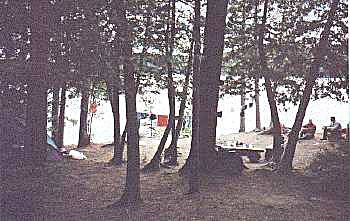 After
setting up camp, we all went for a refreshing swim and
Norm H. had a chance to wash some dirty laundry -
all-purpose bio soap was very efficient. By 5 pm, the sun
had finally broken through the clouds and at sunset, the
light was cast as a variety of blues, pinks and maroons
in various layers among the clouds. Supper consisted of
"chicken blowups", hash browns and gravy with
granola bars and fruits strips as dessert. A fantastic
feast next to none and a job well done by John and Wayne
who did most of the preparation and cooking for this
meal. After supper, we talked about doing another trip
next year, preferably the last week in August down the
Mink, Couchon, Little Couchon, and Cedar Lakes and
return. John has already completed this trip and
recommended it. Looking out over the lake and its
hillside, only a few stars could be seen in the sky and
with a half moon reflecting onto the lake..... it looked
like a calendar picture. The loons were doing their usual
calling in the nearby cove and on the lake. Just a
magnificent scene to absorb. At 11:30 pm, we turned in
for the night. After
setting up camp, we all went for a refreshing swim and
Norm H. had a chance to wash some dirty laundry -
all-purpose bio soap was very efficient. By 5 pm, the sun
had finally broken through the clouds and at sunset, the
light was cast as a variety of blues, pinks and maroons
in various layers among the clouds. Supper consisted of
"chicken blowups", hash browns and gravy with
granola bars and fruits strips as dessert. A fantastic
feast next to none and a job well done by John and Wayne
who did most of the preparation and cooking for this
meal. After supper, we talked about doing another trip
next year, preferably the last week in August down the
Mink, Couchon, Little Couchon, and Cedar Lakes and
return. John has already completed this trip and
recommended it. Looking out over the lake and its
hillside, only a few stars could be seen in the sky and
with a half moon reflecting onto the lake..... it looked
like a calendar picture. The loons were doing their usual
calling in the nearby cove and on the lake. Just a
magnificent scene to absorb. At 11:30 pm, we turned in
for the night.
Copyright
2001 by Norm Hooper
http://www.canoestories.com/hooper1.htm
|